
 English
 Deutsch
 Français
 Português
 Español
 Bahasa Indonesia
 Tiếng Việt
 日本語
日本語
 한국어
한국어
 中文
中文
 ภาษาไทย
 العربية
 Русский
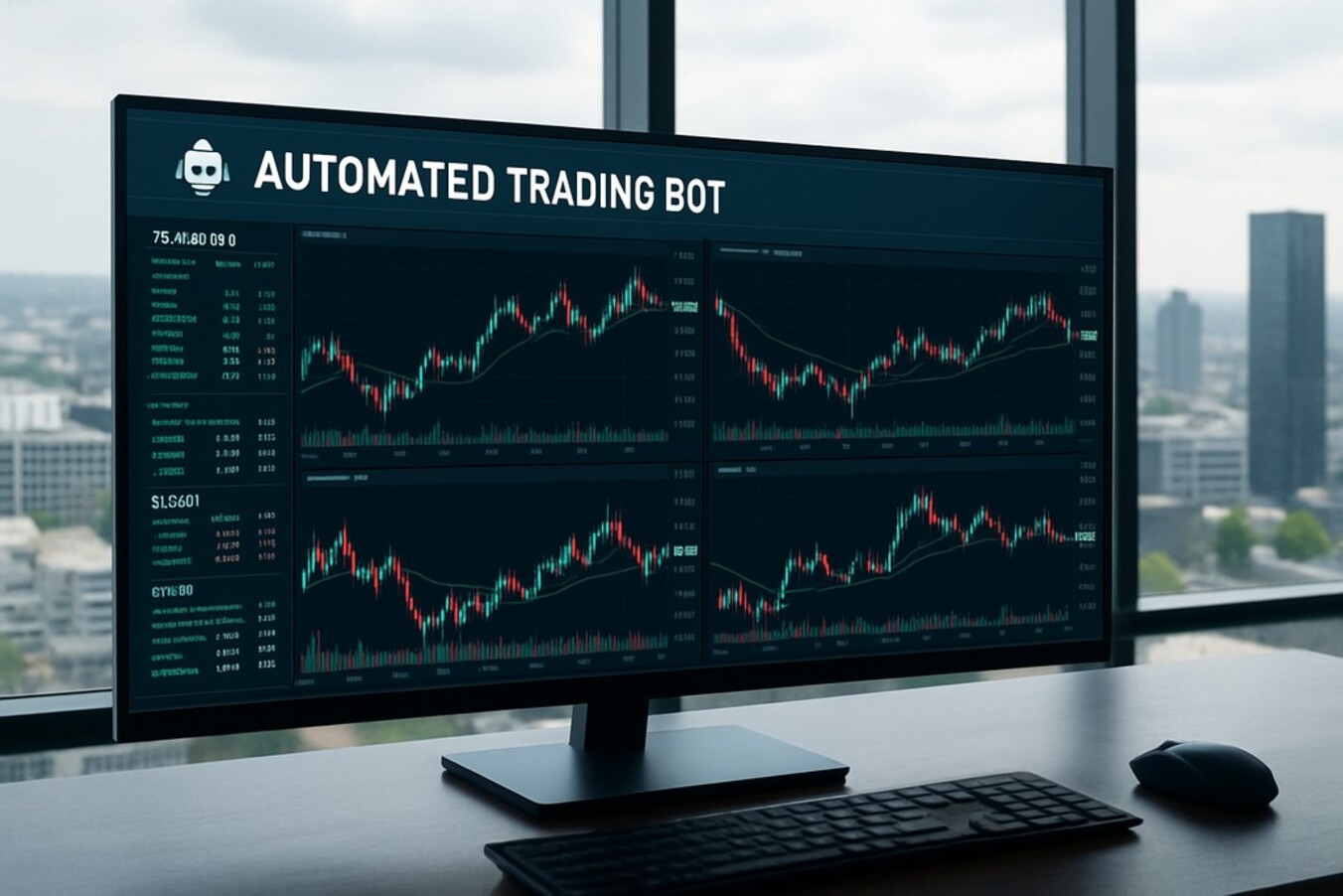
🤖 What are crypto trading bots and how do they work?
🔧 What's Under the Hood: How Crypto Trading Bots Are Built
A trading bot is a specialized program that executes trades on the market independently, following pre-set instructions. It analyzes prices, picks the right moment, and automatically sends orders to buy or sell assets.
It has four key blocks.
👀 First up is the data collection module — the eyes and ears of the entire system. It connects to exchanges via API and pulls in everything: current prices, volumes, the order book, and trade history. The channels might vary—REST or WebSocket, centralized exchanges or decentralized platforms—but the essence is the same: the bot must see the market in real-time.
🧠 Next, the logic module steps in. It takes the data stream and runs it through an algorithm: indicators, signals, rules. If everything aligns, an action command is issued. It doesn't matter what the method is—a simple comparison or a Python model—at this moment, the bot decides: to enter or not.

⚡ Then comes the execution block. It places orders, checks their status, cancels them, and restarts them in case of failures. This is where it's decided whether the bot gets into the trade on time or misses the window. Speed is key: the closer to the exchange and the more stable the connection, the higher the chances of execution without slippage.
📊 The final layer is open position management. The bot must remember which trades are already open, how they are performing, and what to do if the market goes the wrong way. It tracks profits and losses, evaluates portfolio risk, and can close everything if a safety mechanism triggers. And if the bot reboots or the API disconnects, it is obligated to restore its status and sync with the exchange so it doesn't get stuck in a position it doesn't remember.

⚙️ Bot Operating Modes
A trading bot can be a standalone combat machine or an assistant waiting for human confirmation. It all depends on how much control you are willing to hand over.
🔄 In fully automatic mode
The bot doesn't wait for commands—it works strictly according to instructions. As soon as market conditions match the set parameters, it opens and closes positions itself. Human participation is limited to setting up the strategy and defining key parameters at the start.
🤝 In semi-automatic mode
The bot analyzes the market, finds a suitable situation, and proposes a solution: buy, sell, wait. Then, it waits for confirmation. A notification arrives with a brief summary: price, volume, risk, target, etc. The trader either agrees or skips the trade. This approach offers more control but requires attention and slows down reaction time.
🎨 How Strategies Are Created Without Code: Visual Bot Builders
Launching a bot today doesn't require a single line of code. Many platforms function like visual editors: you aren't programming; you're tweaking the bot's behavior through an intuitive interface. Everything is built on the logic of "if one thing happens, do another."
🎯 It all starts with the entry point. You need to define under what conditions the bot should open a trade. This could be a sharp price change, a moving average crossover, or a signal from an indicator. Some look at volumes, others at candlestick patterns. The main thing is to set clear rules so the bot knows when to trigger.
🔍 Next come the filters. They help exclude false signals: for example, the bot won't enter a trade if the market is flat or if the asset isn't trading with sufficient volume. This makes the strategy more precise and robust.
📈 The next layer is position management. The bot needs to understand when to close an open trade. This involves take-profit conditions, stop-losses, trade management logic, and position sizing control.
🧪 After setup, you can run a backtest. The platform will show how the bot would have behaved in the past: where it would have entered, where it would have exited, and how much the strategy would have earned. Only after this is real trading launched.
💪 What Bots Do Better: The Strengths of Automation
Automation solves not just one, but several problems at once—both for beginners and for those who have been in the market for years. It removes routine, eliminates emotions, disciplines the strategy, and allows for action at speeds where a human simply can't keep up.
🌙 The main advantage is that the bot works continuously. Without sleep, breaks, or dependence on time zones. It doesn't get tired of monitoring dozens of charts, doesn't leave to grab coffee right before a crucial candle, and doesn't miss an entry point because it was checking Telegram. For beginner traders, this is a chance not to sit in front of the screen for hours. For the experienced, it's a way to scale a strategy and cut execution costs.
🧘 The second plus is that the bot doesn't care if the market is scary. It doesn't succumb to emotions, doesn't "wait out" a pullback, and doesn't average down a losing position out of spite. Where a human hopes that "it'll grow back in a bit," the bot simply closes at a loss and moves on according to the set logic. This is especially critical in high-volatility trading, where intuition hinders more than it helps.
⚡ Speed of execution deserves a separate mention. The bot places orders via the exchange API—without an interface or manual clicks. Milliseconds decide a lot, especially in scalping, where entering or exiting with a split-second delay can cost the entire profit. While a trader is typing the price and confirming the action, the bot has already received the data, compared it with the conditions, and executed.
📋 There is also discipline. The bot doesn't "outplay" its strategy on the fly, doesn't change the plan depending on the news background, and doesn't ignore stop-losses in hopes of a reversal. It executes what was set: strictly, consistently, without a personal opinion. And that means less chaos, fewer random decisions, and more predictability.
📊 And, of course, scaling. One person can physically watch 1-2 exchanges, maximum 5-6 assets at a moment. A bot is capable of managing trades on dozens of pairs, simultaneously using different strategies, working on different platforms, and taking all set conditions into account.
⚠️ Problems and Limitations
Even the most refined strategy can fail not because of logic, but because of the environment in which it operates. Automation does not grant immunity from technical failures on the exchange side, lag, limits, and architectural constraints. Everything outside your program becomes a potential point of failure.
🐌 One of the main bottlenecks is API latency and exchange infrastructure instability. The bot receives data via an API interface, meaning it depends on how fast the exchange responds. In practice, tens or hundreds of milliseconds can pass between sending a request and receiving a response. For high-frequency strategies, this is enough to lose an entry point or execute a trade at the wrong price. The situation worsens if the bot is physically located far from the exchange servers or if the exchange itself is under heavy load at the moment.
🚫 The next problem is rate limits. Exchanges introduce limits to avoid overloading their systems. Exceed the limit, and you get an error and a block on further requests for a few seconds or minutes. To keep the bot running stably, one has to implement a complex system of queues, timers, and adaptive delays. It is especially important to prioritize requests correctly: critical data like the order book and the last trade must be updated more often than information about deposit history or open positions.
📝 Example: OKX allows no more than 10 REST requests to position history per 2 seconds per user. There are dozens of such limits for each request type. Any bot module working in real-time must account for this, otherwise, the risk of hitting the limits is high.

❌ Strategy Errors: Why Backtesting Is No Guarantee of Profit
Backtesting is a simulation. You take a strategy, run it on historical data, and see what would have happened in the past. But even if the bot showed an impressive result on the chart, it doesn't mean it will repeat it live. And the problem isn't the numbers, but how markets themselves are structured—and how often we overestimate the stability of recurring patterns.
🎯 A common mistake is fitting to history. When a strategy shows a beautiful growth curve on a test, there is a temptation to fine-tune parameters: tighten the entry, tweak the indicator, exclude losing trades. All for the sake of one thing—maximizing profit on the past segment. But the market doesn't live in the past. It changes, and patterns that worked in one phase can completely "break" in another. As a result, the bot becomes over-optimized—it doesn't trade by rules; it reproduces specific conditions of an old scenario.
🔍 For example, Bitcoin might have shown a beautiful figure (looking at the purple arrow), but reality differs. Many market participants expected the start of a drop, since periods of growth were shorter before, but they missed the mark again.

📺 There is another problem: signals not working in real-time. What looked like a reversal on the chart might turn out to be a continuation of the drop in reality.
📰 The algorithm doesn't sense the news background. It sees: "price dropped sharply, time to enter," but it doesn't know that inflation data was released or a regulator blocked an exchange. This creates a "looped behavior" effect: the bot continues to work on logic that is already obsolete.
📈 Looking at the chart again. One could easily have decided that further decline was ahead. But the market decided otherwise.

📉 Market Risks
The technical side is only half the picture. Even perfectly working code is not insured against the market environment in which the bot operates. And here, risks that are not visible in tests come to the fore.
💸 The most obvious is slippage. The bot places an order at one price, but due to volatility, the trade executes at another. On the chart, everything looked beautiful, but in reality, the profit is eaten up. This is especially critical in scalping and working in narrow channels. If you didn't factor slippage into the backtest, the picture will be distorted, and over the long haul, the strategy simply won't turn a profit.
⚠️ There is another threat — stuck orders.
The exchange accepted the order but didn't execute it. Or the bot assumed the position was open, but it didn't go through. This can happen due to an API glitch, a connection timeout, or an error on the exchange side. Without tracking and duplication systems for such orders, the bot simply loses control of the process. To avoid this, advanced solutions implement confirmation timers, backup communication channels, and mandatory position reconciliation with the exchange.
📊 Another risk is changing volatility.
When the market flies up or crashes down, classical logic stops working. A bot tuned for Mean Reversion expects that a price that has gone too far from its conditional "norm" must return. It acts on the scheme: the stronger the deviation, the higher the chance of a pullback. If an asset drops sharply, the bot considers this a temporary dip and buys, counting on a return to the average line. It works—as long as the market really moves back and forth within a range.
But in moments when the asset enters a trend, such logic becomes dangerous. The bot continues to enter buy positions because it sees "oversold" conditions, while the price meanwhile falls further. Or vice versa—the price rises, the bot shorts because it's "too high," and the market flies upward, ignoring signals. The result is a series of losing entries and a total disconnect from reality.
📈 Let's imagine the bot was working within the blue channel on the chart. It looks very clear and consistent. The rate drops by a certain percentage—the bot buys; it grows back—it sells. Everything goes well, but pay attention to the red candle in the bottom right corner. The bot buys again due to the rate deviation from the average, but this time the market changes.

🎯 The bot, tuned for mean reversion, continues to open positions because it sees a deviation from its "working" zone. On the chart, conditional entry points are marked with arrows. In this case, the market actually reversed—and the strategy worked. But in real trading, this doesn't always happen: if the price continues moving in the same direction, a series of such entries can lead to a prolonged drawdown.

🔧 To prevent the strategy from driving the bot into a drawdown during sharp movements, it is supplemented with adaptive logic. Entry levels become movable, filters are activated that evaluate volatility, and if necessary, a pause is triggered. The bot simply shuts down until the market stabilizes.
🚫 When Bots Don't Work: Zones Where Manual Trading Wins
Automation does not mean universality. This is especially noticeable where one needs not just to react to an event, but to understand exactly what is happening—and why.
📰 The first weak spot of bots is trading on news. Algorithms do receive data instantly and can place an order in a flash. But they don't understand the essence of what is happening. A human at that moment not only sees the news but is also capable of quickly evaluating its significance: distinguishing a rumor from a fact, figuring out the source, considering the situation.
🎭 The second zone is unstructured, spontaneous movements that require interpretation. Prices can shift sharply, not because a large order came in or statistics were released, but due to the actions of market makers or manipulation attempts. A human can look at volumes, trace the chain of trades. But a bot cannot. It will trigger at the first match by the indicator and might fall into a trap.
🧠 The third case is intuitive trading, based on experience, a feel for the market, and accumulated patterns. A human notices details: how a candle forms, how a neighboring asset reacts, where stops are placed, who is driving the movement.
🚀 How to Approach Launching a Trading Bot
Before launching a trading bot, it is important to define the basic parameters: what it will trade, by what rules, and in what mode.
📊 The strategy needs to be tested not just on a pretty segment. It is important to run it through different market phases: in an uptrend, in a sideways market (chop), and during periods of high volatility. Only then can you see how the bot behaves.
💱 For beginners, it is reasonable to start with arbitrage approaches. Unlike trend strategies, arbitrage depends less on the directional movement of the price. It works on the difference between instruments, not on guessing where the market will go. One such scenario is arbitrage between spot and futures.
⚙️ The essence is simple: the bot buys an asset on spot and simultaneously opens a short on futures. Profit is formed from two sources: the price difference (spread) and funding payments if they are in your favor.

🔍 The algorithm works like this: it monitors prices on highly liquid pairs like BTC/USDT, ETH/USDT, or SOL/USDT across several exchanges simultaneously. As soon as the difference between spot and futures exceeds a set threshold, the bot simultaneously buys on spot and sells the future. And then—it waits. When prices converge, or funding compensates for the difference, it closes both positions and locks in the profit.
💰 Here is a concrete example. The bot notices that on Crypto.com the pair ETH/USDT is trading at $2461.30, and on OKX the futures contract for the same asset is at $2475.04. The spread is almost $14. The bot buys ETH on spot and opens a short on OKX. While it holds the position, funding is accrued—at the time of writing, it is 0.0051% in our favor. When prices converge or funding covers the remaining spread, the bot exits and locks in the result.


📈 Key Metrics for Evaluating Bot Performance
To avoid turning a trading bot into a slot machine, it is important not just to look at profit, but to understand: where it came from, at what cost, and how sustainable the result is. Below are five key metrics that will help you soberly assess whether the algorithm is working as it should.
💵 PnL (Profit and Loss)
Shows how much you really earned or lost over a certain period. This can be a sum in dollars or in percentages.
How to use: Look at the general dynamic—is it growing or not. But remember: PnL alone is not enough. The bot could have earned +15%, but through a 40% drawdown. Nobody needs that.
⚡ Sharpe Ratio
Shows how effectively the strategy rewards you for risk. That is, how much profit you get for every unit of risk.
If your return is 10%, and risk (volatility) is 5%, the Sharpe ratio will be 2. This is good.
How to use:
- Below 1 — weak strategy
- 1–2 — normal level
- Above 2 — already good
- Above 3 — a sign of a high-quality strategy, but check if it's over-optimized
📉 Max Drawdown
Shows how deeply the bot can dip—from a local peak to a minimum. For example, the account grew to $1000, then fell to $800—the drawdown is 20%.
How to use: Even if the strategy is profitable in the end, a large drawdown indicates risk. Consider not only the size of the drawdown but also how comfortable you are enduring it.
🎯 Win Rate
The percentage of trades that closed in the green. Sounds simple, but there's a nuance: even with a 70% win rate, a strategy can be unprofitable if every losing trade eats up three times more than a profitable one.
How to use: Look not only at the percentage of successful trades but also at the average profit per trade. Win rate only works well paired with the risk/reward ratio.
📊 Profit Factor
This is the ratio of total gross profit to total gross loss. If your bot earned $300 and lost $100 over the entire time, the profit factor = 3.
How to use:
- Above 1 — the strategy is profitable
- 1.5-2 — good level
- 3 and above — sign of a strong strategy, but be careful: sometimes this is the result of a couple of lucky trades
📝 And one more thing: don't forget about logs. If the bot doesn't keep a journal of its actions, you won't understand what it was doing during a failure, a drawdown, or a winning trade. Logs help track execution correctness, find errors, and improve the strategy.
🛠️ How to Launch: Ready-Made Platforms or Your Own Bot
🎨 If you don't want to delve into programming, you can launch a bot on a ready-made platform. It's like a constructor set: choose a strategy, configure parameters via the interface, connect the API. For this purpose, we tried to create a user-friendly trading platform PairTradingPro for automated trading using market-neutral strategies.
💻 The alternative is to write the bot yourself. This requires knowledge: at least basic Python or JavaScript, understanding how exchange APIs work, how to test strategies, and log actions. You get maximum control, but code security, server structure, and risk management rules are entirely on your side. The downside is obvious: you have to write, debug, and maintain it yourself.
🎯 Conclusion
A trading bot is not a way to make money without effort, but a tool that requires tuning, testing, and monitoring. It handles routine perfectly: reacts quickly, follows rules, and doesn't get tired.
🤖 But in moments of instability, the human still wins. Intuition, experience, and flexibility are still out of reach for algorithms.
✅ Successful automation is a smart choice of strategy, understanding of risks, and constant debugging. Then the bot won't replace you, but will become your assistant.
