
 English
 Deutsch
 Français
 Português
 Español
 Bahasa Indonesia
 Tiếng Việt
 日本語
日本語
 한국어
한국어
 中文
中文
 ภาษาไทย
 العربية
 Русский
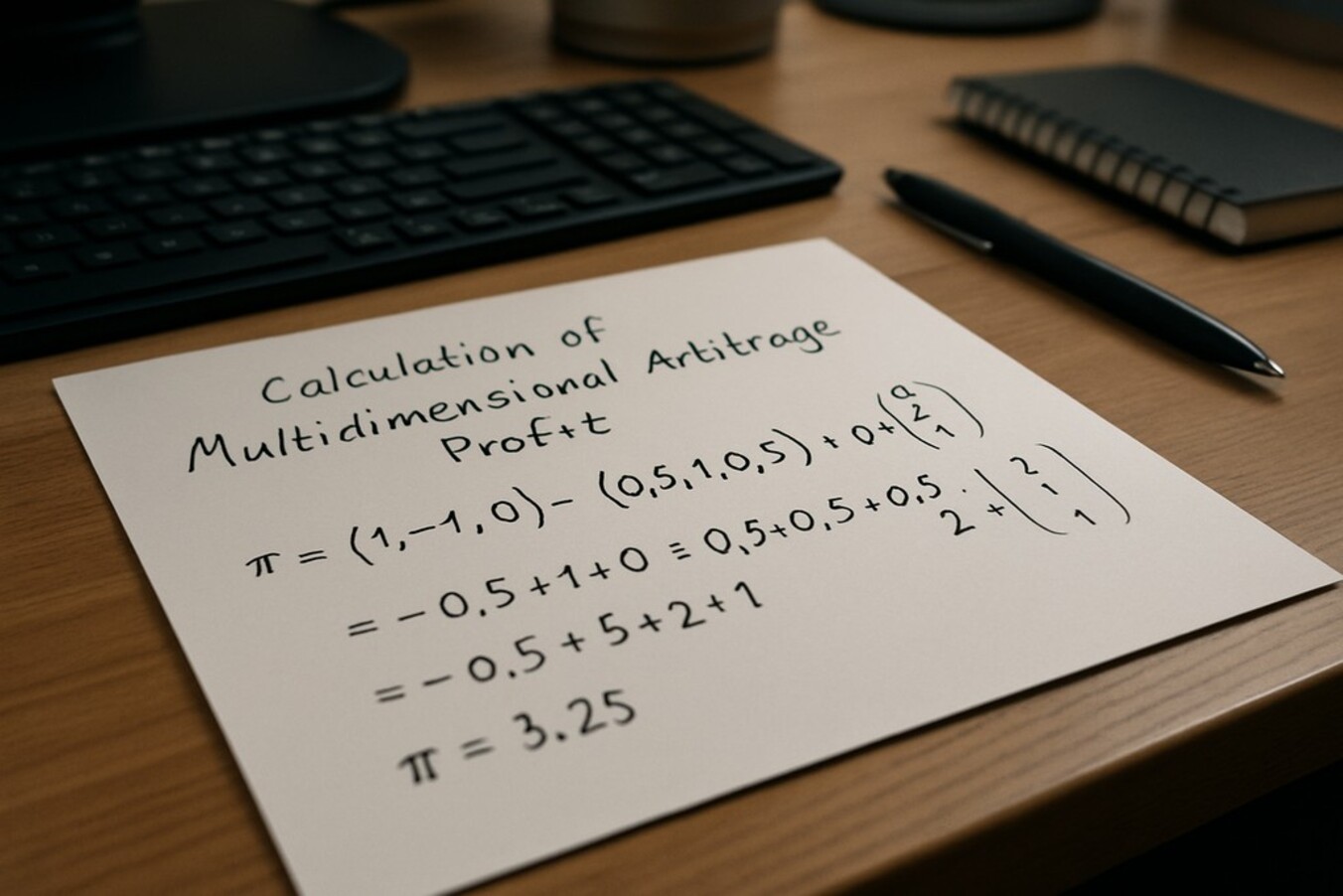
🏛️ Multidimensional Arbitrage: Real Examples of Profit Extraction
📈 1. Classic Arbitrage: Triangular and Polygonal
The most basic yet eternal form of arbitrage within a single venue. The essence lies in finding a chain of exchanges that ultimately yields more of the starting currency.
🔹 Case 1: Triangular Arbitrage on Binance (March 2023)
Situation: Temporary inefficiencies emerged between three trading pairs:
- BTC/USDT: 28,450
- ETH/USDT: 1,780
- ETH/BTC: 0.06329 (Inverse rate: 1 BTC=15.8 ETH)
The Rookie Mistake (Direct Path):
- Buy 1 BTC for 28,450 USDT.
- Sell 1 BTC for 15.8 ETH.
- Sell 15.8 ETH for 1,780 USDT = 28,124 USDT.
❌ Result: Loss of 326 USDT (excluding fees). The market punishes obvious moves.
The Pro Strategy (Reverse Path): The algorithm calculates the synthetic cross-rate and moves counter-clockwise.
- USDT → ETH: Buy ETH with 28,450 USDT. 28,450/1,780≈15.983 ETH
- ETH → BTC: Buy BTC with ETH (Rate: 15.8 ETH per 1 BTC). 15.983/15.8≈1.0115 BTC
- BTC → USDT: Sell the resulting Bitcoin. 1.0115×28,450≈28,779 USDT
✅ Result: Profit of 329 USDT (1.15%) in a split second.
🔹 Case 2: Pentagonal DeFi Arbitrage (November 2022)
Context: Market turbulence following the FTX collapse. Liquidity in "exotic" pools dropped, creating deep spreads.
Chain: USDC→AAVE→LINK→UNI→MATIC→USDC
Execution (Capital: 10,000 USDC):
- USDC → AAVE: Rate 0.01315 (131.5 AAVE).
- AAVE → LINK: Rate 11.2 (1,472.8 LINK).
- LINK → UNI: Rate 1.15 (1,693.7 UNI).
- UNI → MATIC: Rate 7.8 (13,211 MATIC).
- MATIC → USDC: Rate 0.78 (10,304.6 USDC).
✅ Outcome: Net profit 304.59 USDC (3.05%). ⚠️ Risk: The operation took 47 seconds (an eternity for HFT). If the MATIC price had crashed on the final step, the profit would have turned into a loss.
🌉 2. Cross-Chain Arbitrage: Bridges as Profit Sources
Arbitrage between different blockchains (Layer 1 vs. Layer 2). The main challenge here is Bridge Latency.
🔹 Case 3: USDC Spatial Arbitrage (June 2023)
Anomaly: USDC stablecoin traded at different prices across networks due to liquidity shortages in bridges.
| Network | USDC Price | Status |
|---|---|---|
| Polygon | $1.0045 | Overpriced (Sell here) |
| Arbitrum | $0.9985 | Underpriced (Buy here) |
| Ethereum | $1.0000 | Fair Value |
Strategy "Rebalancing" (Capital: $100k): Instead of moving funds back and forth (too slow), the professional holds pre-funded balances on all networks.
- Polygon: Sell 25,000 USDC → Receive $25,112.5.
- Arbitrum: Buy 25,000 USDC for $24,962.5.
- Post-Trade: Slowly transfer cheap USDC from Arbitrum to Polygon to restore balances for the next round.
💰 Math: Instant Delta: 150 dollars. Fees (Gas + Bridge): ≈23 dollars. Net Profit: $127 per trade with zero market risk.
🔹 Case 4: Battle of Wrapped Bitcoins (August 2023)
Situation: Ethereum network congestion (High Gas). Standard arbitrage was unprofitable due to fees, but prices of "different" Bitcoins diverged.
- BTC (Binance): $29,440
- WBTC (Uniswap): $29,385 (Discount)
- renBTC (Curve): $29,320 (Deep Discount)
Multidimensional Solution: The arbitrageur used renBTC as an intermediary to avoid expensive swaps into USDT.
- Buy cheap renBTC on Curve ($29,320).
- Convert renBTC → WBTC via RenVM (low fee).
- Sell WBTC on Binance (deposit via ERC-20) or hedge via Futures Short.
💡 Insight: The complexity of routing (Curve + RenVM + CEX) scared off 99% of bots, allowing a profit of 0.08 BTC (~$2,355) on a turnover of 10 BTC.
⏰ 3. Temporal Arbitrage: Playing with the Future
Unlike spot arbitrage where profit is locked instantly, here the trader exploits time and expectations.
🔹 Case 5: Calendar Spread on Bitcoin Futures (December 2022)
Context: Year-end. Institutions were squaring positions, distorting the futures curve.
| Instrument (Deribit) | Price | Premium (vs Spot) |
|---|---|---|
| BTC Spot | $16,920 | — |
| Futures Dec (7 days) | $16,935 | +$15 |
| Futures Mar (90 days) | $17,180 | +$260 |
| Futures Jun (180 days) | $17,320 | +$400 (Overpriced) |
Strategy "Calendar Spread":
- Sell (Short): 10 BTC June-23 at $17,320.
- Buy (Long): 10 BTC Mar-23 at $17,180.
- Buy (Long): 10 BTC Dec-22 at $16,935.
- Hedge: Sell 10 BTC on Spot.
⏳ Result (January 2023): The curve normalized. Spreads compressed. Total profit from premium differences: $1,000 (~6% in a month) with almost no directional risk.
🔹 Case 6: Volatility and Options (March 2023)
Context: Silicon Valley Bank (SVB) collapse. The market expected chaos, but options were priced unevenly. Put-Call parity was violated.
- Implied Volatility (IV) PUT: 110% (Panic, Overpriced).
- Implied Volatility (IV) CALL: 85%.
- Historical Volatility (HV): 75%.
Structure "Selling Fear":
- Sell expensive PUT $1,500 (Collect premium $85).
- Buy cheap CALL $1,600 (Pay premium $62).
- Delta Hedge: Buy Spot ETH + Short Futures to neutralize directional risk.
✅ Outcome: Realized volatility was lower (65%). The time value (Theta) of the options decayed in favor of the seller. Profit: $2,300 on the strategy with 100 ETH.
🏛️ 4. DeFi Arbitrage: The Alchemy of Yield
🔹 Case 7: Yield Farming Loop (Summer 2022)
Essence: Exploiting interest rate differentials across protocols using leverage.
- Borrow USDC (Aave): at 1.8% APR.
- Deposit USDC (Anchor Protocol): at 19.5% APY.
Scheme (Looping):
- Deposit 100k USDC into Aave as collateral.
- Borrow 75k USDC against collateral.
- Deploy 75k into Anchor (Terra).
- Hedge: Short UST and LUNA futures (to protect against algorithm collapse).
💰 Math: Income: 75,000×19.5%=$14,625. Expense: 75,000×1.8%=$1,350. Net ROI: 13.3% on capital deployed. ⚠️ Finale: The strategy earned ~$4,400 over 4 months but was emergency closed before the Terra/Luna crash thanks to the hedge.
🔹 Case 8: AMM Arbitrage (November 2023)
Context: Rumors of an Ethereum ETF. Liquidity on DEXs was distributed unevenly.
| DEX | ETH Price |
|---|---|
| SushiSwap | $2,089.50 (Buy) |
| Uniswap V3 | $2,095.30 (Sell) |
| PancakeSwap (BSC) | $2,103.20 (Sell Aggressive) |
Combined Attack:
- Buy 10 ETH on SushiSwap ($20,895).
- Instantly sell 5 ETH on Uniswap ($10,476).
- Bridge 5 ETH to BSC and sell on PancakeSwap ($10,516).
- Incidental Arbitrage: Buy cheap BNB with proceeds and bridge back to Ethereum.
✅ Result: Net profit $127 in 15 minutes (ROI 0.6% on turnover).
🌊 5. Macro-Arbitrage: Playing the Regulators
🔹 Case 9: The Regulatory Gap (June 2023)
Situation: SEC lawsuits against Binance and Coinbase. Tokens labeled "securities" (SOL, MATIC) crashed harder on US exchanges.
- Coinbase (US): SOL = $15.20 (Panic).
- Bybit (Offshore): SOL = $16.10 (Calm).
Action:
- Mass buy SOL on Coinbase ($15.20).
- Short SOL on Bybit ($16.10) or sell existing inventory.
- Volume: $500,000.
⏳ Outcome: After 2 weeks, prices converged. The spread collapsed. Profit: $47,000 (~9.4%). A prime example of how fear creates money.
🔹 Case 10: ETF vs. Trust (January 2024)
Context: Spot Bitcoin ETF launch. The legacy Grayscale Trust (GBTC) traded at a discount to NAV, while new ETFs traded at a premium.
- GBTC: Equivalent $45,480.
- Bitcoin Spot: $45,920.
- IBIT (New ETF): $45,980.
Strategy "Convergence": Buy discounted GBTC + Short overpriced IBIT or Futures. Betting that the market would eliminate the inefficiency within 3 months.
✅ Result: The discount vanished. Profit 2.8% for the quarter on a conservative, nearly risk-free trade.
⚡ How to Start: Your Ticket to the Arbitrage World
It might seem that to replicate these cases, you need to be an investment bank with servers located directly on the exchange and million-dollar budgets. That used to be true. But today, technology has been democratized.
You don't need to write code from scratch or rent a rack in a London data center. You need the right tool to handle the math and the speed for you.
🚀 The Solution: PairTrading.Pro
If you want to find market inefficiencies without spending years developing your own algorithms, take a look at the professional terminal PairTrading.Pro.
This is an ecosystem for spread trading and arbitrage that levels the playing field between retail traders and institutions:
- Powerful Spread Constructor: You are not limited to standard pairs. Create your own unique synthetic instruments. Want to trade Spot vs. Futures (like in Case 5)? Or WBTC vs. BTC (like in Case 4)? The Constructor allows you to visualize any spread, automatically calculate coefficients (delta), and see historical correlation in a couple of clicks.
- Ready-Made Strategies: You don't need to reinvent the wheel. Use proven models (pair trading, basket trading) adapted for the current market.
- Low Entry Threshold: You don't need to start with $500,000. PairTrading.Pro allows you to refine your strategy with comfortable amounts, ensuring precise entry and exit thanks to advanced analytics.
- Execution Speed: The terminal is optimized to minimize latency, which is critical when the "window of opportunity" is open for only a few seconds.
🛠 Summary: Instead of fighting the market manually, you get an "exoskeleton" that makes you faster and more precise.
🏁 Conclusion
Multidimensional arbitrage is not just a "money button." It is a philosophy of understanding the market as a single living organism.
- When the SEC releases news, it's not just text; it's a change in the spread between Coinbase and Bybit.
- When the Ethereum network is congested, it's an opportunity for arbitrage via wrapped tokens.
Previously, these opportunities were seen only by the elite. Today, with tools like PairTrading.Pro, you can not only observe these processes but also extract profit from them. The market always strives for equilibrium, and money is simply the reward for the one who helps restore that equilibrium faster than anyone else.
✍️ Article Author: JohnM specially for the PairTrading.Pro community
#PairTrading #Arbitrage #TradingSoftware #CryptoTools #DeFi #SmartTrading #AlgoTrading
