
 English
 Deutsch
 Français
 Português
 Español
 Bahasa Indonesia
 Tiếng Việt
 日本語
日本語
 한국어
한국어
 中文
中文
 ภาษาไทย
 العربية
 Русский
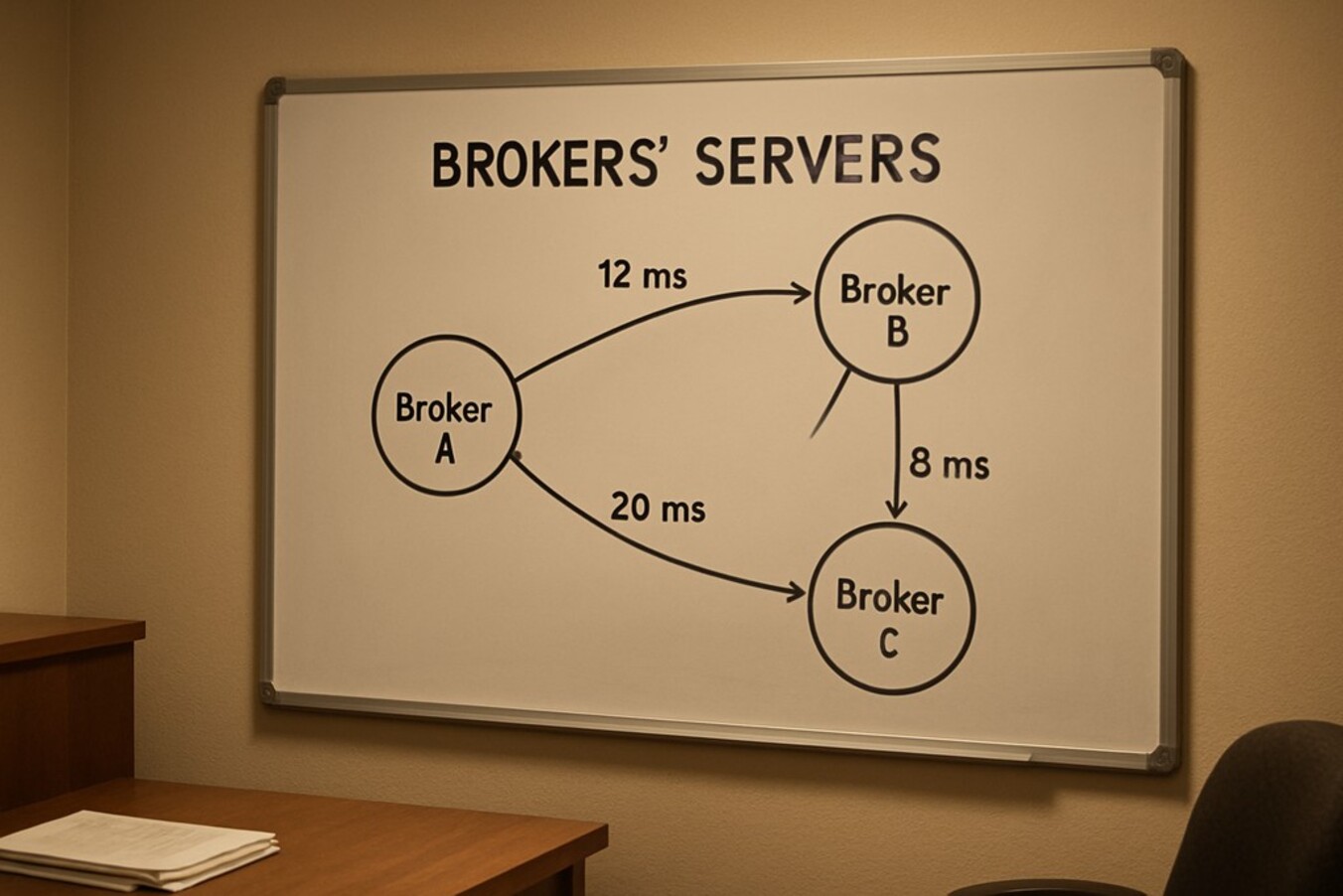
⚡ Latency Arbitrage: When Speed = Money! 💰
🎯 The Core Strategy: We do not predict the market. We know where it is going because it has already happened on one of the venues.
📡 Market Physics: Where Does Latency Come From?
Why don't prices change instantly everywhere in the age of high-speed internet? The answer lies in three types of latency.
1. Geographic Gap (Geo-Latency) 🌍
Light (and signals in fiber optics) requires physical time to cover the distance, for example, from New York to Tokyo.
- New York (NYSE): An event occurs at t=0.
- London (LSE): The signal travels via transatlantic cable in ~30-60 ms.
- Tokyo (TSE): The signal takes ~150-200 ms.
🚀 Arbitrageur's Action: Placing servers "in the middle" or using microwave towers (air transmission is faster than light in glass fiber) to know the price in New York and outpace the main data flow heading to Tokyo.
2. Technological Hierarchy (Tech Latency) ⚙️
Different asset classes have different reaction speeds dependent on liquidity and underlying technologies.
- Futures (CME): The fastest. Robots dominate here.
- Spot (Stocks/Crypto): Slower. Requires time for the transfer of actual assets or bank settlements.
- Synthetics (ETFs): The slowest. Funds must recalculate the Net Asset Value (NAV) of the underlying basket of stocks internally.
3. Liquidity Fragmentation (Exchange Latency) 🏢
A single asset can be traded on multiple venues. Bitcoin trades on 100+ exchanges, Apple shares on 10+ venues (NYSE, NASDAQ, BATS, Dark Pools).
- A large fund buys Apple on NYSE ➡️ Price rises.
- On a "Dark Pool" or a smaller exchange, the price is still old.
- Arbitrage: Buying cheap shares on the slow exchange and instantly reselling them on the fast one.
🏎️ Practical Scenarios: How Money is Made
Scenario #1: The "Time Machine" on News (News-Based) 📰
Here, a battle of NLP (Natural Language Processing) algorithms unfolds.
- 16:00:00.000 — Apple releases a report. Earnings beat expectations.
- 16:00:00.005 — A hedge fund's NLP algorithm "reads" the headline, determines the sentiment as Positive, and sends a buy order.
- 16:00:00.500 — Price on major exchanges (NASDAQ) skyrockets.
- 16:00:01.000 — Retail trader Joe is just opening his news terminal.
- 16:00:02.000 — Price on a remote exchange in Europe or on derivatives has not updated yet.
Action: We buy where they "don't know yet" and sell a second later when they "find out."
Scenario #2: Cross-Venue Arbitrage 🔄
A classic in the crypto market and stock exchanges.
- Binance (Leader): BTC drops sharply to $60,000 due to a large sell order.
- Regional Exchange (Laggard): BTC is still priced at $60,100 because market makers are lagging.
- Arbitrage:
- Buy on Binance for 60,000.
- Instantly sell on the regional exchange for 60,100.
- Profit: $100 with no market direction risk (Delta Neutral).
Scenario #3: Statistical Lead-Lag Effect 🔗
The most accessible method for advanced traders (non-HFT). We utilize asset correlations.
Example: Oil (Leader) and ExxonMobil (Laggard).
- Oil (WTI Futures): The "Leader," reacts to geopolitics instantly.
- ExxonMobil (XOM): The "Follower," a heavy stock involving human investors.
Algorithm:
- Oil futures jump +0.5% in 1 second.
- XOM shares stand still.
- The probability of XOM rising in 5-10 seconds is 90%.
- Trade: Buy XOM ➡️ Wait 10 sec ➡️ Sell for profit.
📊 Deep Dive: Arbitrage Strategies
1. Pure Latency Arbitrage (HFT) ⚡
This is a game for industry giants.
- Hardware: FPGA (programmable chips), microwave towers, colocation (servers located directly inside the exchange building).
- Speed: Nanoseconds (billionths of a second).
- Goal: Outpace another trader's order and buy liquidity before them (legal Front-running).
2. Statistical Arbitrage (StatArb) 📈
This is our territory. We look for mathematical patterns.
- Tools: Correlation matrices, Cointegration.
- Essence: If Asset A and Asset B always "move together" but have currently diverged in time, this is a signal (Mean Reversion).
- Example Pairs:
- Gold Futures ➡️ Gold Miners (GDX)
- S&P 500 (SPY) ➡️ Apple/Microsoft
- USD/JPY ➡️ Japanese Exporters (Toyota, Sony)
- BTC ➡️ Miner Stocks (MARA, RIOT)
⚠️ Risks: The Flip Side
Arbitrage seems like "free money," but that is an illusion.
Q&A on Risks:
❓ What is "Legging Risk"? This is an arbitrageur's worst nightmare. You bought Asset A (the first leg), but while sending the sell order for Asset B (the second leg), the price moved away. You are left with an open directional position and a potential loss.
❓ What is Slippage? Due to your internet latency, you might enter a trade at a worse price than planned. In a narrow arbitrage window, this can turn a profit into a loss.
❓ What are False Breakouts? Sometimes the "Leader" (futures) jerks and immediately returns. If the "Laggard" asset didn't have time to react, you might enter a false trade expecting a movement that won't happen.
🔮 Future: Who Wins the Arms Race?
The evolution of trading speed:
- 1990s: Manual arbitrage via telephone 📞
- 2000s: Internet arbitrage (seconds) 💻
- 2010s: HFT and fiber optics (milliseconds) ⚡
- 2020s: AI and microwaves (microseconds) 🤖
- 2030s: Quantum computing? ⚛️
Major players (Citadel, Virtu, Jump Trading) spend billions on infrastructure. It is impossible for a regular person with a mouse and a chart to compete with them in reaction speed. But there is a solution.
🛠️ How PairTrading.Pro Helps You in This Race?
We understand the reality: you don't have a $10 million microwave tower or a server right in the NASDAQ data center. But the good news is that for StatArb (Statistical Arbitrage) and Lead-Lag strategies, you don't need nanoseconds. You need milliseconds, precise math, and automation.
This is where PairTrading.Pro gives you a decisive edge over the crowd of manual traders. You act as the strategist, and the platform is your high-precision weapon:
✅ Mathematical Precision (OLS, Johansen)
You select the assets (e.g., BTC and ETH), and PairTrading.Pro handles all the complex mathematics. You don't need to guess the ratios. Our models (OLS Regression, Johansen Cointegration) instantly calculate ideal weights and build a synthetic spread. You get a professional Hedge Ratio that is impossible to calculate manually in real-time. 🧮⚖️
✅ Reaction Speed (Instant Execution)
While a human sees a movement, processes it, and reaches for the mouse button (losing 0.5–1.5 seconds), our algorithms are already ready to act. You capture profit in those very "golden seconds" while others are just waking up. 🖱️🚫
✅ Legging Risk Protection
This is the main feature. The platform sends orders as a packet, synchronizing buying and selling. If you try to do this manually, the risk of being left with a "naked" leg is huge. We minimize this risk, making trade entry safe and balanced. 🛡️🔗
👉 Conclusion: You won't outrun light or Citadel's HFT robots. But with PairTrading.Pro, you are guaranteed to outrun 99% of other traders trying to trade these strategies "by eye"! 🏎️💨
✍️ Author: JohnM #LatencyArbitrage #HFT #PairTrading #AlgoTrading #StatArb #QuantitativeTrading #FinTech
