
 English
 Deutsch
 Français
 Português
 Español
 Bahasa Indonesia
 Tiếng Việt
 日本語
日本語
 한국어
한국어
 中文
中文
 ภาษาไทย
 العربية
 Русский
💰 Cryptocurrency Arbitrage in 2026: How to Profit from Price Differences
🔍 What is Arbitrage?
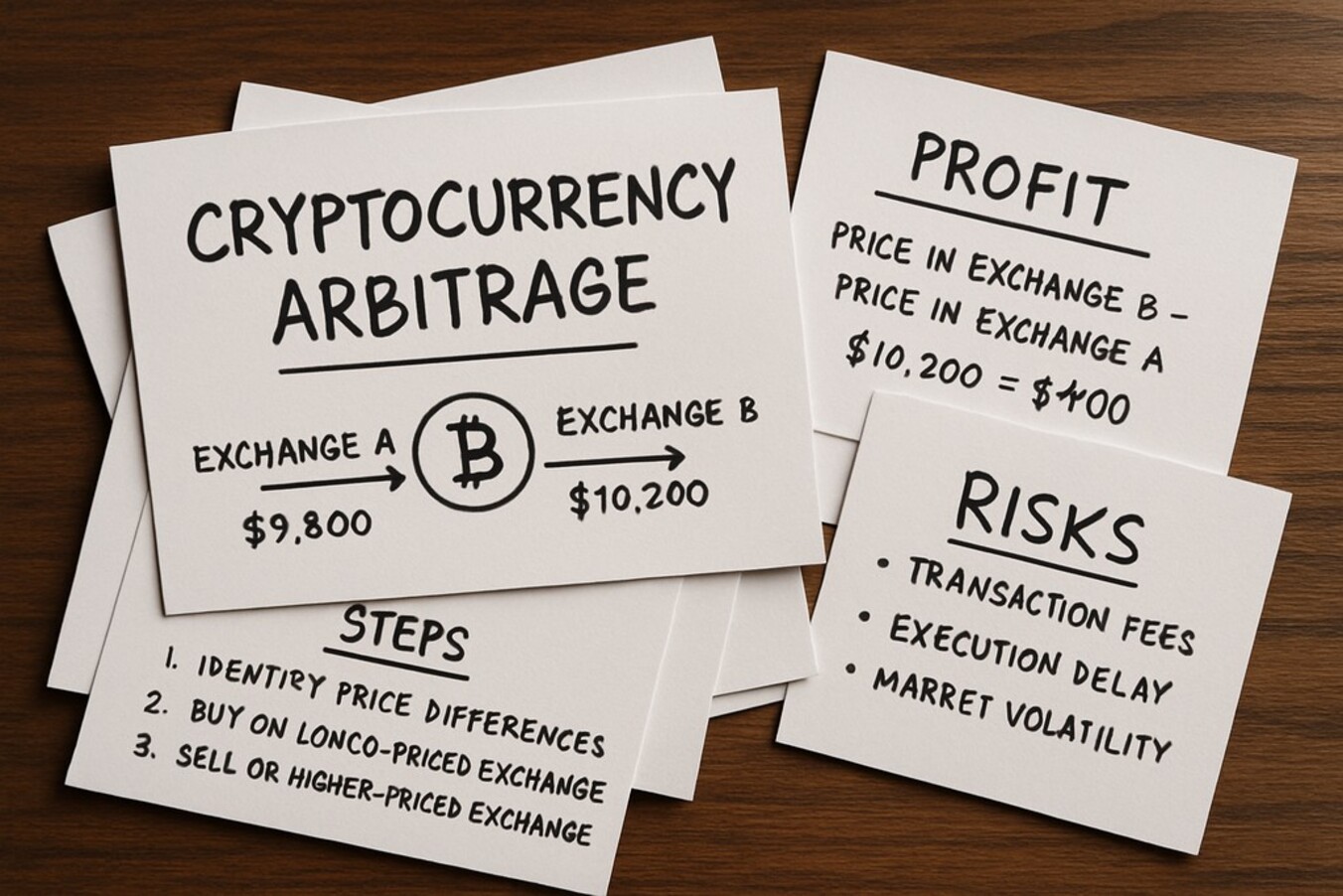
Imagine this: you visit one exchange and see Bitcoin at $96,900, while on another exchange, it's trading at $97,200. 💰 If you buy on the first one and immediately sell on the second, the price difference goes straight into your pocket. That is arbitrage. ⚡
No betting on growth or decline: crypto works differently here, allowing you to profit from short-term differences in rates. 📊 All you need is to spot this difference and act on it in time. The key skills here are speed and calculation.
Essentially, crypto arbitrage is a set of strategies relevant for both beginners and experienced traders. 🎯 The choice depends on your level, infrastructure, and goals.
📈 Types of Arbitrage
🤝 P2P Arbitrage
The scheme is simple: buy cryptocurrency for fiat on one platform, then sell it for a higher price on another. Or even on the same platform — but at a different rate. 💱
Example: You buy USDT for $0.99, and sell it for $1.05. The difference is your profit. All on one platform. 💸
It works especially well in countries with currency restrictions. 🌍 There, arbitrage allows you to profit from rate differences even with low liquidity. The main thing is to check limits, commissions, and bank cards, and be ready for surprises from banks. ⚠️ The card is often the bottleneck in a P2P chain.
🔄 Inter-Exchange Arbitrage
Prices for the same cryptocurrency can differ across different exchanges. 📊 This is normal: every exchange has its own trading volume, audience, and reaction speed to news. Arbitrage exploits these discrepancies. The goal is to buy cheaper on one platform and sell higher on another. 🎯
To do this, you must have active accounts on both exchanges. 💼
Also — deposits must be funded in advance: to buy on one exchange and simultaneously sell on another, you need the assets already in your accounts. ⚡ If you try to transfer assets between exchanges at the moment of the trade, the price will change, and the arbitrage window will close.
Example: On one exchange BTC costs $93,800, and on another — $94,310. 💰 You buy Bitcoin where it's cheaper and immediately sell where it's more expensive. Subtract commissions — and you have a net profit, even if it's small.


⚠️ What to Consider:
- Transfer speed between exchanges
- Deposit and withdrawal fees
- Order book volume: if there's insufficient liquidity, you won't sell at the needed price
- Professionals use bots, APIs, and even servers near exchange data centers to execute faster than competitors. 🤖
🏠 Intra-Exchange Arbitrage
Intra-exchange arbitrage involves finding price discrepancies within a single exchange, between different trading pairs. 🔍 Instead of moving funds between platforms, you work within one ecosystem.
Suppose you see three pairs: 📊
🔹 ETH/BTC — one rate
🔹 BTC/USDT — another
🔹 ETH/USDT — a third
Theoretically, the ETH/USDT rate should be equal to ETH/BTC × BTC/USDT. But due to market inertia, delays, and liquidity imbalances, this is not always the case. ⚡
📝 Example:
ETH/BTC = 0.06
BTC/USDT = 30,000
ETH/USDT should be 0.06 × 30,000 = 1,800 USDT
But if you see ETH/USDT = 1,825 — you can make money by quickly selling ETH at the inflated rate. 🎯
🔺 Triangular Arbitrage
This is a special case of intra-exchange arbitrage, but it works strictly with three currencies. 📐 It works great on platforms with many pairs. 💎
📊 Spot-Futures Arbitrage
Futures often cost more than spot prices — especially during periods of high volatility or increased demand. 📈 This is called contango. Earnings come from fixing the difference between "expensive/cheap" and closing both positions when the market balances out.
Example: If the Bitcoin futures price is $97,500, and the spot price is $97,100, you: 💰
🔹 Buy BTC on spot (cheaper)
🔹 Open a short position on futures (more expensive)
When the futures and spot prices converge, you close both positions and lock in the profit. 🎯
🌍 Cross-Market and Hybrid Chains
This is combined arbitrage where you work across different markets or with different types of cryptocurrencies. 🔄 These schemes often use rate differences between different countries, exchanges, or segments — from P2P to DeFi.
Example (Fiat Arbitrage):
In Argentina, you buy USDT on P2P at the local peso rate, where 1 USDT = 1300 ARS. 🇦🇷 You send it to an exchange and sell it at the global rate, equivalent to 1 USDT = 1400 ARS. Profit comes from exchange rate differences and currency restrictions. 💰
📊 Statistical Arbitrage
Not all arbitrage revolves around split-second price discrepancies. 📈 Statistical arbitrage is a strategy for those who can dig into data and spot repeating patterns. If two tokens usually move in sync, but now one has suddenly broken away — this could be a signal. 🔍
Example: COMP and AAVE. If AAVE is growing and COMP is lagging, you can buy COMP and simultaneously sell AAVE. The idea is that over time they will "converge," and you will profit from this correction.
To do this, you'll need at least basic skills in Python and libraries like pandas to process data and calculate things like Z-score. 🐍
🤖 Automating Arbitrage
A human needs time to compare prices and click. ⏰ A bot takes milliseconds. In conditions where a chain lives for less than a minute, this is critical. 🚀
💻 Why is automation needed?
- Reaction speed — you blink, and the bot has already closed the deal ⚡
- 24/7 Operation — no weekends or fatigue 🕰️
- Less emotion — a machine doesn't doubt, get greedy, or panic 🧠
🚀 How to start if you're not a programmer?
Use platforms for search and automated trading, for example, PairTradingPro. 💼 Test chains on demo accounts. Learn from templates: many share basic scripts on forums and GitHub. 👥
💥 What Breaks Arbitrage: Technical and Market Risks
- Delays and Technical Lag: The exchange API freezes, and your chain becomes outdated. ⏰
- Slippage: You expected one rate but got another. The profit evaporates. 📉
- Commissions: Typical rookie mistake — transaction fees eat up the spread. 💸
- Restrictions: Exchanges might delay withdrawals or banks might block cards. 🏦
🎯 Conclusion
Cryptocurrency arbitrage is a story about precise calculation and systematic work. 📊 It is methodical, calibrated work where numbers, speed, and accuracy matter. ⚡
If you are seriously interested in how to earn on cryptocurrency in 2026, arbitrage is still here. 🚀 It's alive, kicking, and profitable. The main thing is not to look for a "magic button," but to test, search for different chains, and try again — and you will definitely succeed! 💪
